

Last Updated on September 29, 2026 by Domenica
Traditional banks are notorious for charging high overdraft fees when they overdraw their checking accounts. These fees are costing everyday Americans billions of dollars each year!
Many traditional banks still charge overdraft fees of $34 to $37 per transaction, though some have cut or dropped them. Bank of America now charges $10, and Capital One and Citi charge none. A 2024 federal rule that would have capped overdraft fees at $5 for large banks was repealed by Congress in 2025, so banks still set their own fees.
| TRADITIONAL BANKS | OVERDRAFT FEE | DIGITAL BANKING | OVERDRAFT FEE |
|---|---|---|---|
| Bank of America | $10 | Chime | $0 |
| Chase | $34 | One Finance | $0 |
| Regions Bank | $36 | Axos Bank | $0 |
| Fifth Third Bank | $37 | Ally Bank | $0 |
| TD Bank | $35 | Current | $0 |
| KeyBank | $20 | Majority | $0 |
| Truist Financial Corporation | $36 | MoneyLion | $0 |
| Wells Fargo | $35 | Monzo | $0 |
| PNC Bank | $36 | SoFi | $0 |
| US Bank | $36 | Juno | $0 |
Most large banks now cap overdraft fees at three per day. At $35 each, that’s still up to $105 in fees in a single day.
Luckily, digital banks have introduced new models and policies around overdrafts.
Most digital banks allow customers to spend more money than they have in their accounts without paying a fee.
We chose the best digital banks on the market that allow overdrafts without fees.
READ ALSO: How Digital Banking Helps You Save Money
1. Current
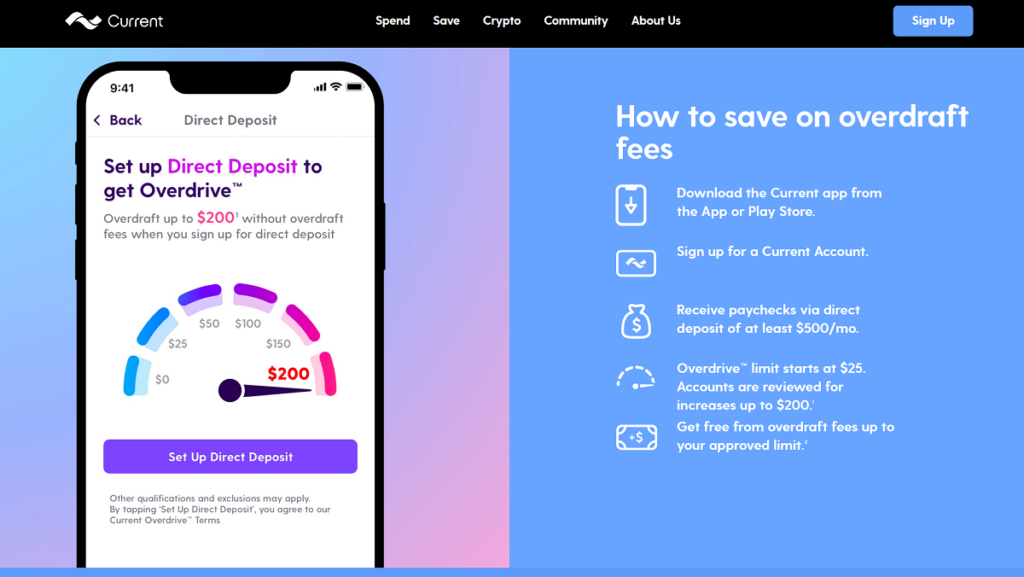
- Fee-free overdraft up to $200
- Points and cashback
- Instant Current transfers
- Cash deposits at 60,000 stores
- Free ATM withdrawals
- Gas hold refunds
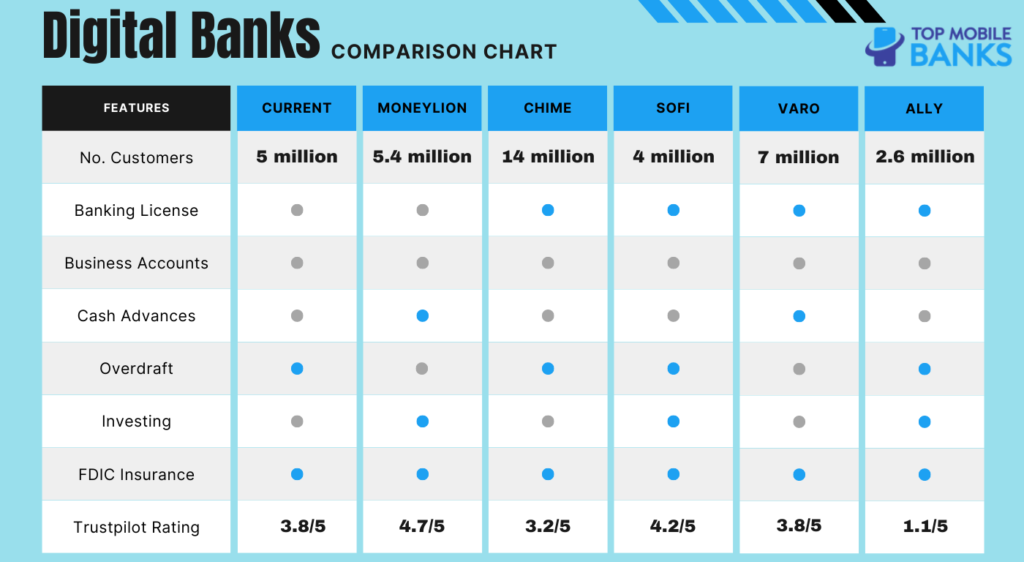
Current, a digital bank with around 5 million customers, is one of the simplest and best companies in the industry.
They offer a no-frills checking account that has no fees, early payday, cash back, fee-free ATMs, and even teen accounts. All of the features and benefits are now completely free, whereas you had to pay a monthly fee to access the more advanced features and teen banking.
The company also offers savings pods which are basically separate savings accounts. They come with a superb 4.00% APY. Another great thing about these pods is that you can access your money anytime without restrictions or penalties.
Next, there’s a crypto trading platform where you can buy and sell the 27 most popular cryptocurrencies for as little as $1.
Lastly, and the reason why we’re here, is the overdraft. Namely, Current offers overdraft with no fees for people that receive paychecks via direct deposit of at least $500 per month.
That’s the main requirement. The overdraft limits start at $25 and can potentially increase to up to $200 after your account is reviewed.
The next time you get a deposit into your account, the amount will cover the negative balance.
You need to know that Overdrive only functions with debit card purchases. Transactions such as ACH, Current Pay transfers, checks, and ATM withdrawals don’t apply.
2. Chime
- Fee-free overdraft with SpotMe
- Savings account
- Spending account
- Credit builder
- Two days early paycheck
- 2.0% APY on savings accounts
Chime is one of the most popular digital banks in the US. It was established in 2013 and offers checking accounts at no fee, as well as a high-yield savings account.
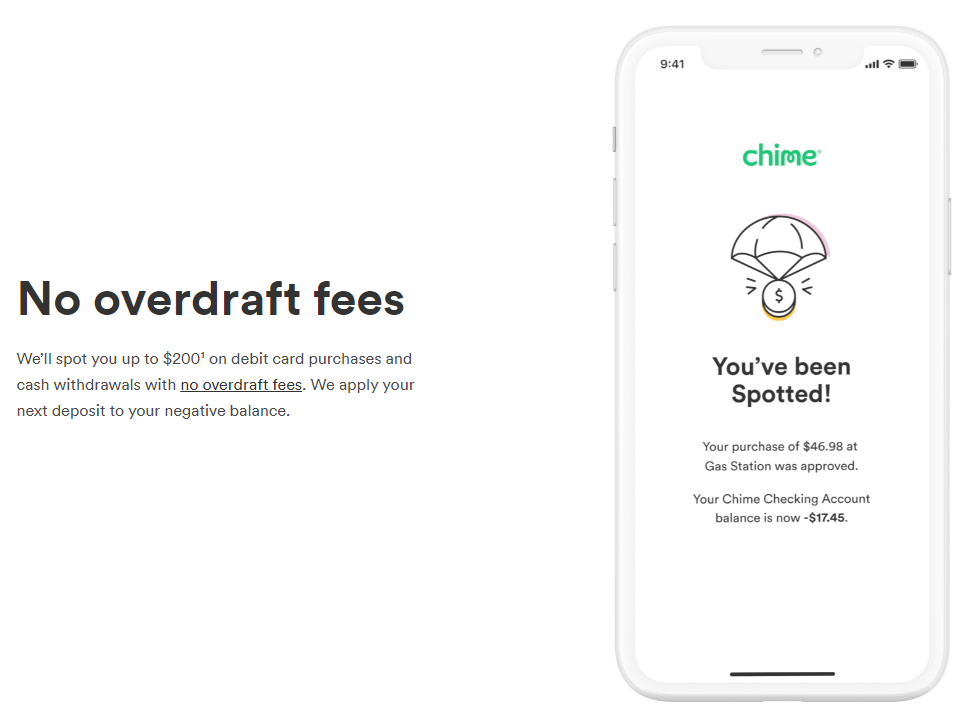
Chime offers its customers overdrafts at no cost via the feature SpotMe. If you need to draw more than you have in your account, Chime will spot you up to $200 on your cash withdrawals and debit card purchases.
To be eligible for SpotMe, you need to receive $200 or more in qualifying direct deposits to your Chime Checking Account each month and have an activated Chime debit card or Credit Builder card.
Once you qualify, you can overdraw $20 on purchases and cash withdrawals for a start. Chime may then increase your limit up to $200 or more based on your account history, spending activity, direct deposit amounts, and frequency.
This limit will be displayed on the Chime mobile app, and it will send you notifications when your limit changes.
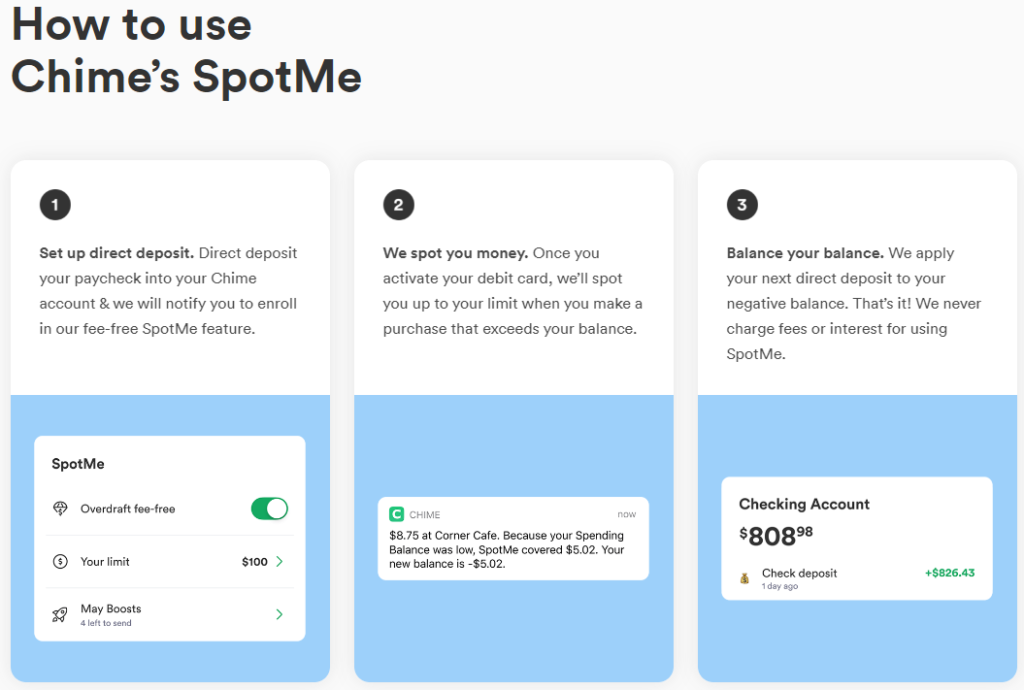
Although SpotMe doesn’t charge any overdraft fees, you might incur third-party costs with ATM transactions. The feature also doesn’t cover non-debit card transactions such as ACH transfers or Checkbook transactions.
Lastly, Chime provides its customers with a Chime Credit Builder Visa Credit Card to build their credit scores. With direct deposits, you can receive your paycheck two days early, and all your deposits are FDIC insured for up to $250,000.
3. SoFi
- Overdraft protection
- No monthly fees
- Saving, spending, and investing accounts
- Loans available
- Credit score and budgeting assistance
- Access to thousands of fee-free ATMs
- Mobile deposits
- Cash deposits and withdrawals
- Financial and estate planning
- Career counseling
SoFi is more than a digital bank. It’s a one-stop shop for your finances. It offers everything from checking and savings accounts to personal, student, auto and mortgage loans, as well as credit cards, insurance, and investing.
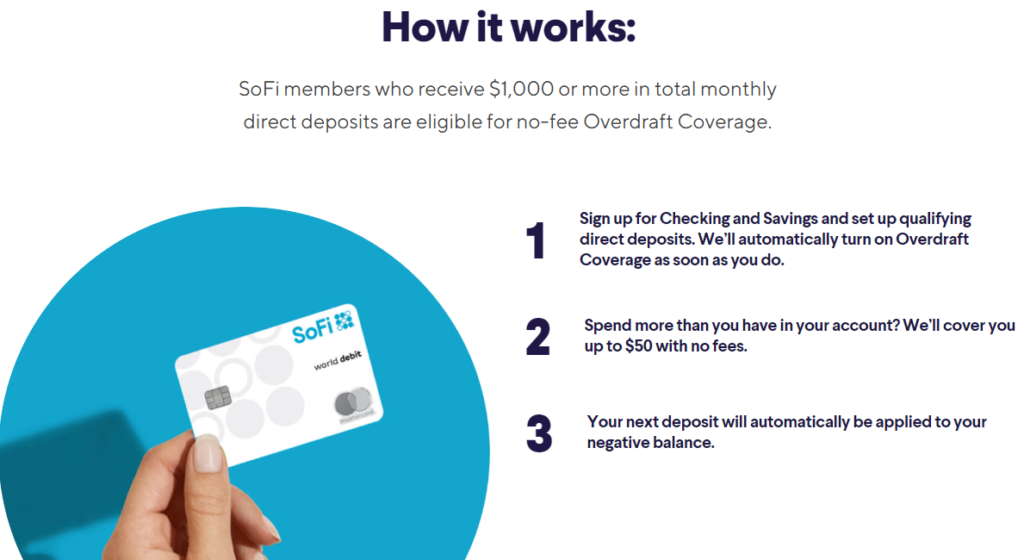
Of course, SoFi also has no-fee overdraft coverage. SoFi covers up to $50 in negative balances on debit card purchases (not P2P transfers, bill pay or checks).
You will have to have a SoFi checking and savings account and set up direct deposits. You’ll also have to receive $1,000+ in total monthly direct deposits.
4. Ally
- No overdraft fees
- Overdraft Transfer Service
- Checking account
- Savings account
- Free ATM withdrawals
- 1.50%-4.10% APY with a High Yield CD
- 3.00% APY on savings account
- Personal loans and mortgages
Ally is one of America’s biggest digital banks. The digital-only banking division of Ally Financial Inc. offers its customers at no fee for all types of accounts. Every Ally Bank customer is eligible, and they have no restrictions.
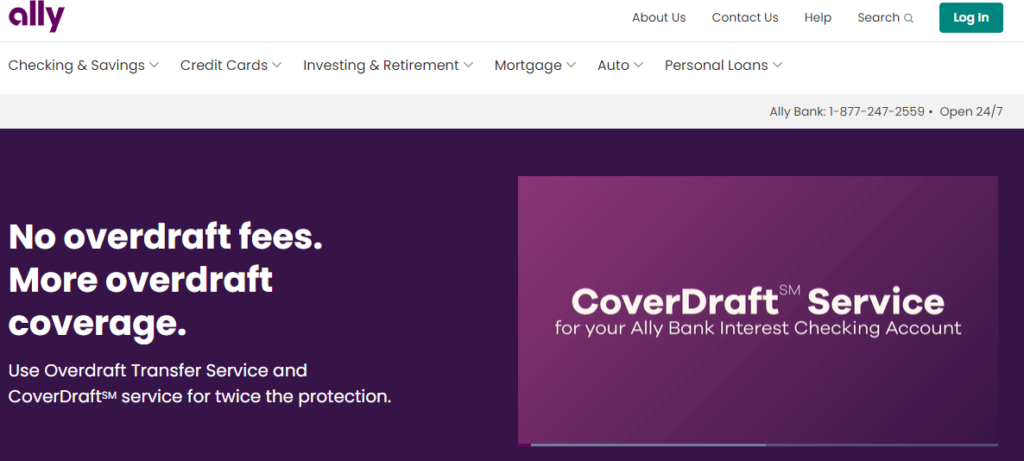
If you don’t have enough money in your account to cover a transaction, you can get overdraft coverage once you sign up for the Overdraft Transfer Service.
This service automatically transfers available funds in $100 increments from your savings account or money market to cover your purchases.
Ally will move these funds to your checking account at no fee. Also, keep in mind that if you don’t set up this Overdraft Transfer Service and your card is declined, the bank will not charge you an overdraft fee.
You can sign up for this service by logging into your account and selecting the linked account you want to transfer funds to.
Apart from the checking account services, Ally also offers high yield certificates of deposit (CDs), mortgages, home loans, individual retirement accounts (IRAs), and investment advisory services through Ally Invest.
READ NEXT: 6 Reasons Why Digital Banks Are The Future Of Banking
5. MoneyLion

- $500 fee-free overdraft
- Early paycheck
- Zero ATM fees at Allpoint
- Price protection
- Rewards on spending
- $19.99 /mo Credit Builder Plus
- $1,000 Credit Builder loan
- ETFs investing
Next up on our list is MoneyLion.
So, why is this excellent bank in the last place on this list? It’s because they don’t really offer overdrafts. However, they don’t have any overdraft or overdraft protection fees as well. If you don’t have enough funds in your account, your transaction will simply get declined.
If you’re strapped for cash, MoneyLion’s Instacash offers advances of up to $500 with no interest or mandatory fees. Instant delivery costs extra.
To become eligible for cash advances, all you have to do is link your checking account.
Limits start small and grow with recurring deposits in your linked account. Switching your direct deposit to a MoneyLion RoarMoney account can raise your limit to $1,000.
6. Varo
- Early direct deposit
- No monthly fees
- Checking account
- Debit card
- Savings account
- Early Direct Deposit
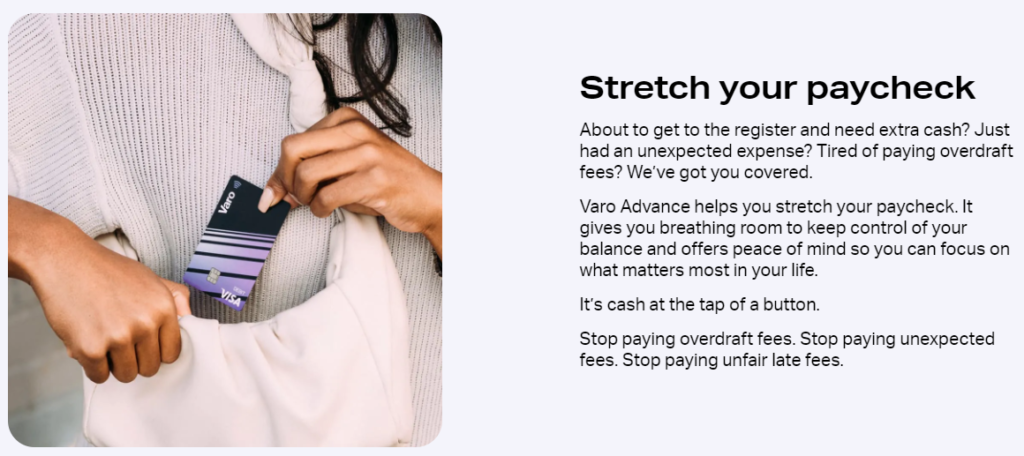
- Up to $500 Varo Advance
- Free ATM Withdrawals
And, last but not least, we have Varo – the first consumer fintech to get a national bank charter.
Varo also doesn’t offer overdrafts per se but, similar to MoneyLion offers cash advances. However, to use cash advances, you don’t have to go to $0 on your account. Initial limits range from $20 to $250 and can grow to $500 over time.
There are some requirements, though:
- Your Varo account has to be older than 30 days
- It needs to be active
- You need $800+ in qualifying monthly deposits to your Varo account (or a linked external account with ongoing direct deposits)
Each advance carries a flat fee based on the amount, shown in the app before you accept.
RELATED: Cash App Overdraft (Is It Available?) Plus 4 Alternatives
Overdraft Protection Vs. Overdraft Coverage
Banks have found innovative ways to provide overdrafts to their customers. To make the service better, they offer either overdraft protection or overdraft coverage. As a customer, you also need to distinguish between the two features.
Federal rules require banks to get your opt-in before charging overdraft fees on ATM withdrawals and one-time debit card purchases. Checks, recurring payments and ACH transactions aren’t covered by that rule, so they can still trigger fees.
Overdraft Coverage
With this feature, the bank will advance you cash to make a purchase when you don’t have sufficient funds in your checking account. In some cases, the bank will increase your limit depending on your account history.
Overdraft Protection
On the other hand, you can link your checking account to another account with funds such as savings or money market funds with overdraft protection. The eligible funding account differs depending on the specific bank.
In this alternative, if you don’t have enough funds in your checking account, the bank will transfer cash from your linked account to pay for the purchase.
How to Avoid Overdraft Fees
If your account always runs into low balances, here are a few tips to avoid overdraft fees.
Switch Banks
If you have accounts in a bank that still charges overdraft fees, especially the traditional banks, you can switch to a digital bank with better or no fees.
Most digital banks will not charge you a monthly maintenance fee or an overdraft fee and will offer some form of coverage and protection. Therefore, you don’t have to stick with an expensive bank, as there are other cheaper alternatives.
Track Your Account Balance
The simplest way to avoid paying any overdraft fees is by watching your account balance closely.
Digital banks provide all the services via their websites or mobile apps, making it easy to track your spending and balances on the go.
Use the available online banking tools to your advantage to ensure your account doesn’t run into a negative balance.
Link Checking Account to Savings Account
If your bank has this alternative, you can link your checking account to the savings one. This way, the bank can transfer funds when you are running low on cash and need to purchase.
Also, ensure your savings account has enough money to cover the necessary expenses.
Set up Bank Notifications
Another way to monitor your account and spending is by signing up for alerts and notifications via email or mobile apps.
You can set up a low-balance alert to keep you in the loop about how much money is available in your account.
Once you notice your funds are low, you can deposit more cash, minimize spending or cancel some payments in advance.
Don’t Opt In to Overdraft Coverage
Under federal law, banks can’t charge overdraft fees on ATM withdrawals or one-time debit card purchases unless you opt in. If you don’t opt in, those transactions will simply be declined when you don’t have enough money. Other transactions, like checks and automatic payments, can still overdraw your account.
Conclusion
Digital banks are way ahead of traditional banks in terms of fees and simplicity but also overdrafts.
Overdraft fees fall hardest on people with the least cushion in their accounts, which is why many digital banks have dropped them in favor of fee-free coverage and cash advances.
We covered some of the best digital banks on the market, and they, too, offer overdraft protection or cash advances.